High heeled shoes don’t become flats if you break the heels off.
The posts of earrings aren’t sharp.
Nail polish takes a long time to dry and smudges when wet.
You can’t hold in a period like pee.
Inserting a tampon is not arousing or sexual in any way, ever.
Feel free to add your own.
– Bras leave red marks on the skin under and around boobs and it is a magical experience when taken off.
– Make up can take anywhere from 5 to 25 minutes depending on how skilled you are.
– Taking hair out of a ponytail after wearing it for hours does not make it perfectly straight when it comes down.
– Hair when wet sticks to the skin it no longer flows, idiot.
-When women with long hair kiss, turn around, do anything, their hair falls in the way.
– Stockings are itchy and tear like wet paper bags.
– Pantyhose, tights, leggings, and stockings are each different.
– Waxing hurts and leaves red skin for a while afterwards while shaving leaves stubble
– Most can’t run in heels unless they have been VERY worn
– Insecurity in appearance doesn’t mean “buy me a drink”
– EVERYONE HAS DIFFERENT TASTES IN EVERYTHING
-Having large breasts sucks. It sucks beyond belief. If a garment happens to fit your large chest, odds are it won’t fit the rest of you. Underboob sweat is real and terrible. Bending over for extended periods of time will tweak your back out. Running can be painful due to boob turbulence. Bras are hella expensive. Big breasts are not fun.
Putting a tampon in isnt a quick bend-poke-done kinda deal. It involves cubicle yoga, messy hands, numerous curse words as you realise it isnt in correctly and have to take it out and start again with a new one.
Yes to all of this. But also:
If her hair is in an updo, one does not simply remove a hairpin to send her hair cascading down her back. No. If her hair is an updo, it will take at least an hour and an extra set of hands to remove the 137 bobby pins that are holding her hair in place. Furthermore, there’s probably a can’s worth of hairspray in there, intended to withstand category 2 hurricane winds. There’s no cascading happening here – the best you can hope for is a misshapen nest of hair to clump and poof unattractively in the back while it still remains flat against her scalp.
This is one of the funniest posts I’ve seen in a while (especially if you read all the comments), but also really depressing because at 42 I still judge myself as having failed for not matching up to all these mythical stereotypes despite knowing they’re impossible
^^^This though
The odds of a woman having smoothly shaved legs and armpits are directly proportional to the amount of skin her clothing bares and/or the amount of fucks she gives at that particular moment.
GLASSES ARE NOT COSMETIC. If we whip them off, we do not become gorgeous fashion models. We become squinty.
-most women wear bras. Yes, even when they are trying to dress sexy. Because bras make boobs look perkier and rounder, which is something men apparently find sexy, so being a seductress or femme fatale is not an automatic reason for a female character to not be wearing a bra.
-a good bra will hide headlights, or at the very least drastically reduce their noticeability. A women with enough pointy nipple issues will opt for a padded or molded bra to hide them.
-women’s nipples do not automatically become hard pyramids visible through any and all layers of clothing the second they become even slightly aroused. They are not the female equivalent of boners. And even if their nipples do get hard, the bras they are almost certainly wearing (because even a goddamn succubus with big, honkin’ knockers for seducing men is gonna have those painful puppies in some kind of boob sling) should keep those pointy nipples from being visible to every other character in the scene, JIM BUTCHER. YES, EVEN LARA RAITH WOULD WEAR A BRA ONCE IN A GODDAMN WHILE.
if you’re being tied up and tortured in a freezing underground dungeon, then you probably have more important things to pay attention to than how hard somebody’s nipples are, jim butcher
– Wearing a bra that doesn’t fit HURTS. It’s not sexy to wear a bra that’s “two sizes too small”, it’d make your clothes hang oddly and you’d have a weird, uncomfortable “quad-boob” effect and your back would hurt, BEN AARONOVITCH.
Also, after removing a too small bra, there’s gonne be angry red lines on the boobs and ribs and the lady is not going to want them to be touched by anyone for a good long while
-Not all women wear heels. Those things hurt and are hard to balance in. They can also mess up your feet and back pretty bad.
-Lips aren’t just naturally red “as if she’d been drinking wine but they were just like that without makeup cause she’s so perfect,” my dear little Kvothe from ‘Name of the Wind’. Also, girls do not naturally smell like fruit or flowers, it’s either perfume or something she’d been eating recently.
I’ve been appreciating this post but now it’s back very specifically calling out my problematic faves and I don’t think those male authors realize how much it totally takes me out of the story for a moment when they commit these errors. It does nothing useful for the plot and is annoying for half of the audience
Is it weird that I’m female and wasn’t aware of a solid third of these?
I mean, all writes take note. I basically live in man land when it comes to protagonists so I don’t know half these things despite being a woman
(Most) Women do not look at themselves in the mirror and compare their breasts to fruit. Any sort of fruit. Especially melons. Please save us from the melons.
Also we are not aware of our breasts at all times. I do not walk down a flight of stairs and think “oh golly my breasts are bouncing so much right now”. They are as much as natural part of our bodies as arms. Do you constantly think about how your arms are moving? Sure you may be aware of them, but paying full attention? Doubtful.
Also: women working out are almost never sexy. They’re not glowing or glistening or (kill me) *sparkling*. They are red and sweaty and gross just like all the dudebros doing their time with the dumbbells. Stop ogling fictional women at the gym, TOM WOLFE.
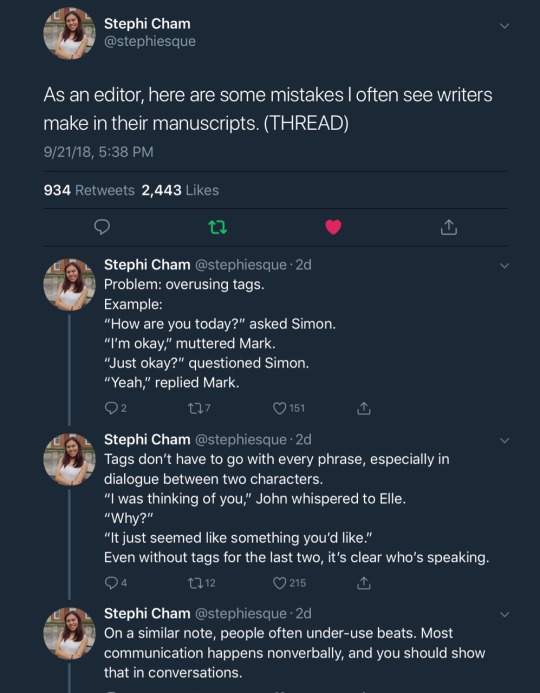
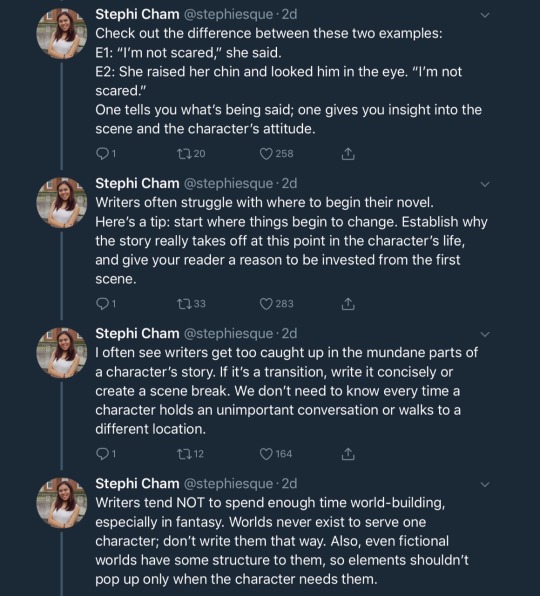
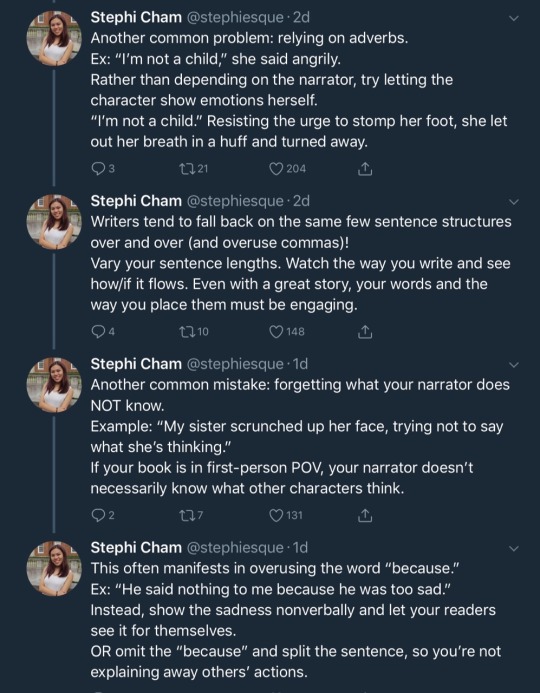
This. This is good fiction writing advice. I really appreciate how it was formatted as “this is a common problem, here is a solution to try in your own work” and not “oh god, don’t do that!” without any extra help. And I extra appreciated the “don’t rely on adverbs” bit, because they do have their place but they aren’t the only way actions can be emphasized.
me: haha oh god this is so bad im making so many unsupported claims and pulling all this analysis out of my ass
my prof in the margins: excellent analysis!
me:
when i was in high school i used to write my papers thinking wow i’m just bullshitting all of this. then like a week before my senior year ended after all the grades were set, i was talking to my english teacher and told him you know i just bullshitted every paper i wrote. he told me that while i may have thought i was just pulling it all out of my ass, i genuinely knew what i was talking about and made well-supported analyses. i only thought i was bullshitting because it didn’t take much effort and it all seemed obvious to me. if you do well on your essays even though you think you’re just making it up as you go, chances are you’re not pulling it out of your ass. you’re just a genuinely talented analyst, even if the analysis that you’re making comes from a subconscious understanding of the material rather than a conscious effort to study it. give yourself some credit.
Honestly, I think the whole “don’t pay the writers” thing boils down to the notion that everybody thinks they can write. It’s the old saw about the novelist at a cocktail party having to hear someone say, for the millionth time, “I’d love to write a book someday.”
Someone–Stephen King? Pretty sure I saw this in a Stephen King foreword–once said they’d like to say to a brain surgeon, “Boy, I’d love to do brain surgery someday.”
We treat “the ability to put words into a sentence” like it’s just the same as “the ability to form a coherent narrative that engenders a variety of emotions within the reader and puts them in a scene and shows them what they didn’t see before”.
And that’s like me drawing a stick figure and saying I’m an artist.
Writers are constantly devalued because everyone thinks they have a book in them and don’t realize the level of skill and commitment it takes to finish even a short story, much less a whole book.
This goes well beyond fandom, but man, I would’ve hoped fandom would know better.
Just about every writer out there has several go-to websites that they use when it comes to their writing. Be it for creativity, writer’s block, to put you in the mood or general writing help. These are mine and I listed them in hopes that you’ll find something that you’ll like or find something useful. I’ve also included some websites that sounded interesting, but I haven’t tried out yet.
Spelling & Grammar
Grammar Girl – Grammar Girl’s famous Quick and Dirty Tips (delivered via blog or podcast) will help you keep your creative writing error free.
The Owl – is Purdue University’s Online Writing Lab (OWL), an
academic source from Purdue University (which is in West Lafayette, Indiana,
U.S.). It’s contains plenty of grammar guides, style tips and other information that can help with your writing, it’s especially great for academics.
Tip of My Tongue — have you ever had trouble of thinking of a specific word that you can’t remember what it is? Well, this site will help you narrow down your thoughts and find that word you’ve been looking for. It can be extremely frustrating when you have to stop writing because you get a stuck on a word, so this should help cut that down.
Free Rice – is a great way to test your vocabulary knowledge. What’s even better about this site is that with every correct answer, they donate 10 grains of rice to the United Nations World Food Program. So, please disable your adblock since they use the ads on the site to generate the money to buy the rice.
HyperGrammar – is from the University of Ottawa (a bilingual public research university in Ottawa, Ontario, Canada) that offers up a one-stop guide for proper spelling, structure, and punctuation. Being that this comes from a Canadian university, that means that they use standard
Oxford English Dictionary spelling. Basically that means you’ll get British English, which differs slightly from formal American English.
AutoCrit – the AutoCrit Editing Wizard analyzes your manuscript to identify areas for improvement, including pacing and momentum, dialogue, strong writing, word choice and repetition.
It also provides a number of other writing resources as well. It’s not free, but they do offer 200 characters for analysis at no charge. It’s $29.97 per month or $359.64 for an annual membership.
ProWritingAid – is another automatic editing tool that analyzes your writing and produces reports on areas such as overused words, writing style, sentence length, grammar and repeated words and phrases. They offer a free sample, but you have to make an account to try it out. It’s $3.33 per month ($40 annually, or less if you purchase a longer license).
Writer’s Digest– learn how to improve your writing, find an agent, and even get published with the help of the varied blogs on this site.
Paper Rater – uses Artificial Intelligence to improve your writing. It includes grammar, plagiarism, and spelling check, along with word choice analysis. The basic version is completely free, but they do offer
premium subscription for people seeking more advanced features. If you’re interested it’s $14.95 per month or $95.40 per year if you decide to get it.
Syntaxis – it allows you to test your knowledge of grammar with a ten-question quiz. The questions change every time you take the quiz so users are sure to be challenged each time around. It definitely helps writers know if there’s something that they need to brush up on.
Word Frequency Counter – this counter allows you to count the frequency usage of each word in your text.
EditMinion – is a free robotic copy editor that helps you to refine your writing by finding common mistakes.
BBC – has a section for helping you with your skills, especially in writing, from grammar to spelling, to reading, to listening and to speaking.
Tools
Copyscape – is a free service that you can use to learn if anyone has plagiarized your work. It’s pretty useful for those that want to check for fanfiction plagiarism.
Plagium – is another a copy detection system, that provides a very similar service to Copyscape and uses Yahoo! rather than Google to perform its searches. Just keep in mind that searches for simple text up to 25,000 characters remains free of charge, but any larger requires credits to be purchase.
Write or Die – is an web application for Windows, Mac and Linux which aims to eliminate writer’s block by providing consequences for procrastination. It lets you try it for free, but the desktop version is
available for $10. The Write or Die iPad app is $9.99 in the App Store. If you’re really old school, the original web app can still be launched with its modest settings.
Written? Kitten! – is similar to Write or Die, but it’s a kinder version and it’s completely free. They use positive reinforcement, so every time you reach a goal they reward you with an adorable picture of a kitten.
Fast Fingers – offers you an easy way to improve your typing skills. It’s puts you through a quick typing game that tests your typing speed and improves it at the same time. It’s also a great way for writers to warm up.
Information & Data
RefDesk – it has an enormous collection of reference materials, searchable databases and other great resources that can’t be found anywhere else. It’s great to use when you need to find something and/or check your facts.
Bib Me – it makes it easy to create citations, build bibliographies and acknowledge other people’s work. This is definitely something that academics will love. It’s basically a bibliography generator that automatically fills in a works cited page in MLA, APA, Chicago or Turbian formats.
Internet Public Library – is a non-profit, largely student-run website managed by a consortium, headed by Drexel University. Currently this online library is inactive, but it’s still full of resources that are free for anyone to use, from newspaper and magazine articles to special collections. Just keep in mind that it’s not up to date, since they stopped maintaining it on June 30, 2015.
The Library of Congress – if you’re looking for primary documents and information, the Library of Congress is a great place to start. It has millions of items in its archives, many of which are accessible right from the website.
Social Security Administration: Popular Baby Names – is the most accurate list of popular names from 1879 to the present. If your character is from America and you need a name for them, this gives you a accurate list of names, just pick the state or decade that your character is from.
WebMD – is a handy medical database loaded with information. It’s not a substitute for a doctor, but can give you a lot of good information on diseases, symptoms, treatments, etc.
– is the National Institutes of Health’s web site that contains information about diseases, conditions, and wellness issues in language you can understand. It also offers reliable, up-to-date health information, anytime, anywhere, for free. You can use the site to learn about the latest treatments, look up information on a drug or supplement, find out the meanings of words, or view medical videos or illustrations. You can also get links to the latest medical research on your topic or find out about clinical trials on a disease or condition.
Mayo Clinic – is a nonprofit medical practice and medical research group.
World Health Organization (WHO) – is a specialized agency of the United Nations that is concerned with international public health.
Its current priorities include communicable diseases, in particular HIV/AIDS, Ebola, malaria and tuberculosis; the mitigation of the effects of non-communicable diseases; sexual and reproductive health, development, and ageing; nutrition, food security and healthy eating; occupational health; substance abuse; and driving the development of reporting, publications, and networking.
Google Scholar – is an online, freely accessible search engine that lets users look for both physical and digital copies of articles. It searches a wide variety of sources, including academic publishers, universities, and preprint depositories and so on. While Google Scholar does search for print and online scholarly information, it is important to understand that the resource is not a database.
The Old Farmer’s Almanac – this classic almanac offers yearly information on astronomical events, weather conditions and forecasts, recipes, and gardening tips.
State Health Facts – Kaiser Family Foundation provides this database, full of health facts on a state-by-state basis that address everything from medicare to women’s health.
U.S. Census Bureau – you can learn more about the trends and demographics of America with information drawn from the Census Bureau’s online site.
Wikipedia – this shouldn’t be used as your sole source, but it can be a great way to get basic information and find out where to look for additional references.
Finding Data on the Internet – a great website that list links that can tell you where you can find the inflation rate, crime statistics, and other data.
Word References
RhymeZone – whether you’re writing poetry, songs, or something else entirely, you can get help rhyming words with this site.
Acronym Finder – with more than 565,000 human-edited entries, Acronym Finder is the world’s largest and most comprehensive dictionary of acronyms, abbreviations, and initials.
Symbols.com – is a unique online encyclopedia that contains everything about symbols, signs, flags and glyphs arranged by categories such as culture, country, religion, and more.
OneLook Reverse Dictionary – is a dictionary that lets you describe a concept and get back a list of words and phrases related to that concept. Your description can be a few words, a sentence, a question, or even just a single word.
The Alternative Dictionaries– is a PDF, that contains a list of slang words in all types of languages, such as Arabic, Chinese, Japanese, Norwegian and many, many others. There use to be a website, but it’s not there anymore and this is the next best thing I could find.
Online Etymology Dictionary – it gives you the history and derivation of any word. Etymologies are not definitions; they’re explanations of what our words meant and how they sounded 600 or 2,000 years ago.
MediLexicon– is a comprehensive dictionary of medical, pharmaceutical, biomedical, and health care abbreviations and acronyms.
Merriam Webster Online – the online version of the classic dictionary also provides a thesaurus and a medical dictionary.
Multilingual Dictionary – it translate whatever you need from 30 different languages with this easy-to-use site.
Writing Software
Open Office – why pay for Microsoft products when you can create free documents with Open Office? This open source software provides similar tools to the Microsoft Office Suite, including spreadsheets, a word processor, the ability to create multimedia presentations, and more.
LibreOffice – is a free and open source office suite. It was forked from OpenOffice.org in 2010, which was an open-sourced version of the earlier StarOffice. The LibreOffice suite comprises programs to do word processing, spreadsheets, slideshows, diagrams and drawings, maintain databases, and compose math formula.
Scrivener – is not a free program, but it’s certainly a very popular one. It’s great for organizing research, planning drafts, and writing novels, articles, short stories, and even screenplays.
OmmWriter – is for Mac OS X, a free simple text processor that gives you a distraction free environment. So you can focus only on your writing without being tempted or distracted by other programs on your computer. They are currently working on a Windows version of their software as well, so keep an eye out for that if you’re interested.
designed to immerse you in your writing. It keeps your writing space simple and clean without sacrificing functionality. It includes a daily goal tracker, work count and time spent writing. There’s also spell checking, real-time feedback on variables like word and page count, and tabbed document browsing. It’s available for Windows, Mac and Linux.
Q10 – is a free portable distraction-free writing tool for Windows. The interface includes nothing but a tiny bar at the bottom that displays the character, word, and page count—you can toggle the bar off for a totally distraction free workspace.
Evernote – is a free app for your smartphone and computer that stores everything you could possibly imagine losing track of, like a boarding pass, receipt, article you want to read, to do list, or even a simple typed note. The app works brilliantly, keeping everything in sync between your computer, smartphone, or tablet. It’s definitely a useful app for writers when you have ideas on the go.
ScriptBuddy – is a full-fledged screenplay software program. It handles the proper screenplay format automatically, so you can concentrate on your story. It is easy to use and the basic version is free.
TheSage – is a free application, which is a comprehensive English dictionary and thesaurus that provides a number of useful and in some cases unusual search tools.
Sigil – is ideal for e-book authors because it’s a free EPUB editor with a stack of essential features.
WriterDuet – is a collaborative screenwriting app for working with writing partners in real-time. It also lets you copy text written in Fountain, or other screenwriting programs (Final Draft, Celtx, etc.) and paste it directly into WriterDuet with the correct formatting most of the time. They offer the basic version for free, WriterDuet Pro ($9.00 monthly, $79 yearly and $199 lifetime) and WriterDuet Premium ($299 yearly). WriterDuet works on Mac, Windows, Linux, Chromebooks, iOS, and Android. It gives identical page counts on all devices, and PDFs.
ZenWriter – is a program that gives you an open, peaceful place for composing your thoughts without any distractions. It’s a fullscreen text editor that offers
customizable backgrounds, music, and a nifty word count at the bottom of the window. It’s not free, but it does offer a free trial for 15 days. It is available for Windows, and after the 15-day trial period you can choose to purchase it for
$17.50 if you want.
WriteMonkey – is a Windows writing application with an extremely stripped down user interface, leaving you alone with your thoughts and your words. It is light, fast and free. It’s also an portable app, so you can stick it on a USB drive and use in on whatever computer you happen to find yourself at.
YWriter5 – is a free word processor and is designed for Windows XP, Vista and beyond. It’s a small but very comprehensive tool which helps you to plan your story. It breaks your novel into chapters and scenes, helping you to keep track of your work while leaving your mind free to create. You can set up deadlines, for instance, and the program’s Work Schedule report will let you know how much you’ll have to do, each day, to finish on time. You can even enter your characters, locations and items and freely organize them into scenes. This definitely sounds like it’ll be useful for NaNoWriMo writers.
Kingsoft Office (WPS Office) – is an office suite for Microsoft Windows, Linux, iOS and Android OS. The basic version is free to use, but a fully featured professional-grade version is also available. This software allows users to view, create and share office documents that are fully compatible with dozens of document formats, including Microsoft PowerPoint, Word and Excel. In other words, the format is similar to a Microsoft Word document (.DOC or .DOCX file) and supports formatted text, images, and advanced page formatting. Kingsoft Writer documents can be converted to Microsoft Word *.doc files in the software.
Creativity, Fun & Miscellaneous
National Novel Writing Month – is one of the most well-known writing challenges in the writing community. National Novel Writing Month pushes you to write 50,000 words in 30 days (for the whole month of November).
WritingFix – a fun site that creates writing prompts on the spot. The site currently has several options—prompts for right-brained people, for left-brained people, for kids—and is working to add prompts on classic literature, music and more.
Creative Writing Prompts – the site is exactly what it says. They have 100+ and more, of prompts that you can choose from.
My Fonts– is the world’s largest collection of fonts. You can even upload an image containing a font that you like, and this tells you what it is. Just keep in mind that not all of the fonts are free.
DaFont – has lot of fonts as well, most of them are completely free to download. However, some are demo versions or are only free if you used it for personal use and not commercial use.
Story Starters – this website offers over one trillion randomly generated story starters for creative writers.
The Gutenberg Project – this site is perfect for those who like to read and/or have an e-reader. There’s over 33,000 ebooks you can download for free.
The Imagination Prompt Generator– click through the prompts to generate different ideas in response to questions like “Is there a God?” and “If your tears could speak to you, what would they say?”
The Phrase Finder – this handy site helps you hunt down famous phrases, along with their origins. It also offers a phrase thesaurus that can help you create headlines, lyrics, and much more.
Storybird – this site allows you to write a picture book. They provided the gorgeous artwork and you create the story for it, or just read the stories that others have created.
Language Is a Virus – the automatic prompt generator on this site can provide writers with an endless number of creative writing prompts. Other resources include writing exercises and information on dozens of different authors.
Background Noise/Music
SimplyNoise – a free white noise sounds that you can use to drown out everything around you and help you focus on your writing.
Rainy Mood – from the same founders of Simply Noise, this website offers the pleasant sound of rain and thunderstorms. There’s a slide volume control, which you can increase the intensity of the noise (gentle shower to heavy storm), thunder mode (often, few, rare), oscillation button, and a sleep timer.
Coffitivity – a site that provides three background noises: Morning Murmur (a gentle hum), Lunchtime Lounge (bustling chatter), and University Undertones (campus cafe). A pause button is provided whenever you need a bladder break, and a sliding volume control to give you the freedom to find the perfect level for your needs and moods. It’s also available as an android app, iOS app, and for Mac desktop. If you go
Premium it’s $9 and you’ll get 1 year of unlimited listening to their audio tracks and access to three more sounds: Paris Paradise, Brazil Bistro and Texas Teahouse.
Rainy Cafe – it provides background chatter in coffee shops (similar to Coffitivity) AND the sound of rain (similar to Simply Rain). There’s also individual volume and on/off control for each sound category.
MyNoise – is a website with multi-purpose noise generator that is completely free.
It helps you to focus while working in a noisy environment or to help settle your anxiety and it’s also useful in cases of insomnia or tinnitus. It has so many sounds to choose from: Fish Tank, Clockwork, Gregorian Chants, Traffic Noise, and so on.
MyNoise: Online Fire Noise Generator – is also from NyNoise, but it’s a short-cut link for those that only want to hear the sound of fire crackling in a fireplace.
Snowy Mood – is a noise generator that plays sounds of boots walking through snow on an endless loop. It’s simple and straightforward, and perfect for those days when you feel like being snowed in.
background noise generator that helps you to drown out annoying noises in order to create your perfect environment for working and relaxing. You can mix different sounds together, such as rain and a train or fire and the night sound of crickets or with the waves at a beach.
8tracks – is an internet radio website and everyone can listen for free, well it use to be completely free. Unlike other music oriented social network such as Pandora or Spotify, 8tracks doesn’t have commercial interruption (that’s if you get 8tracks Plus). Users can create free accounts and can either browse the site and listen to other user-created mixes for as long as they like, and/or they can create their own mixes. It’s a perfect place to listen to other writer’s playlist, share yours or find music for specific characters or moods. Note: Joining is still free, however you’re now limited to 1 hour of free listening for each week (or more depending on how much people like your mixes, but I’ve been told the limitation is for those in the US only). If you want unlimited access it’s $30 per year or $5.00 a month.
Playmoss – with 8tracks no longer having free unlimited listening and no commercial interruptions many people looked for an alternative and Playmoss is what 8tracks use to be. Playmoss is free to join and it has all the same basic features that 8tracks has, only with extra goodies like unlimited skips, able to see the entire tracklist before playing, start at any point in the playlist, see how many playlists contain a certain song and even collaborate playlists with other people.
pet peeve: when the main character is always the most boring character in a series bc the creator is writing them to be as broadly appealing as possible. LET YOUR MAIN CHARACTER BE A UNIQUE AND INTERESTING PERSON PLEASE IM BEGGING YOU



 XI's Archived Tumblr Blog