Alternate title: “SIXER, DO NOT PET THE GIANT SHARK-DOG!”
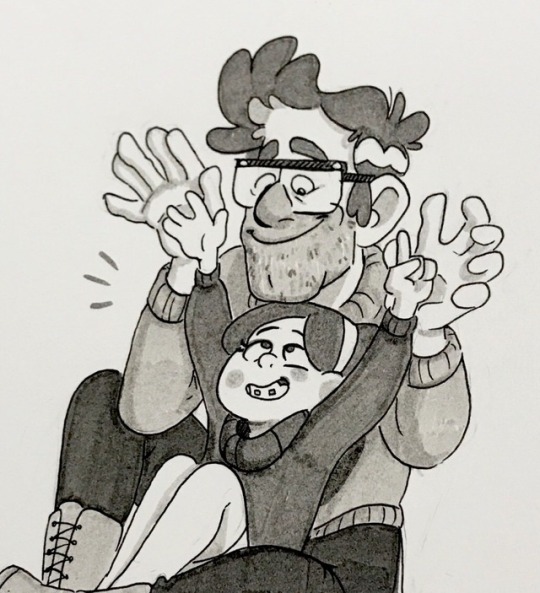
My entry for the @gfwayfaringstrangerszine—of the brothers’ encounter with the Haida legend, Wasgo—the sea wolf. Don’t worry, it’s probably just a playful puppy, so the Stans are safe (so long as they don’t go sporting the skins of aquatic animals).
Pre-orders are over, but it looks like the zines will be re-listed come June 18th! Be sure to check out the blog for more details.
definitely ddamd, it’s a treasure trove of ford information and ford’s first proper introduction
it got me to fall in love
i reference the transcript so often that google just knows to add “ungeons dungeons and more dungeons” when i type “gravity falls d”
“don’t let it taste human flesh!!!” said so dramatically, plus ford has custom 6-fingered shock gloves, plus everyone knows he staged the whole thing because just wants to get to know his family
“i’m sorry, dipper, but on the dark weird road i travel, i’m afraid you cannot follow. –well, call me for dinner!” said with such an abrupt change in tone and making for such a perfect example that i repeatedly use this single moment to check & confirm the validity of my ford characterization, time and time again
“my work is far too dangerous for a single living soul to spend even one second i– wait! is that a 38-sided die from dungeons, dungeons, and more dungeons?!” like WHAT DID I SAY, this is the exhibit 1b to the exhibit 1a above
“my boy, do you know what this means? we must stop everything i’ve been working on at once… and PLAY!” this says so much about him and what it says is that he’s perfect, i love him
“hm. the old boy looks a bit different than he did back in my day.“ fuckign… using “my boy” and “old boy” like some sort of sherlock holmes era gentleman… what the fuck i love this weird old man’s use of language
“if i rolled it, anything could happen. our faces could melt into jelly. the world could turn into an egg. or you could just roll an eight. who knows.” i love how he explains things because it prevents him from leaning too hard into the whole scientist thing he tries to have going on for himself. not once does he go on and list elements or compounds while staring at some sort of specimen; not once does he rattle on for ages using copious scientific jargon. all you need to see to know that he’s a scientist is the work he’s done and the concepts he understands; all you need to hear to know that he hasn’t quite been here for a while is his use of words. he’s just so… well-crafted.
and that’s hot
dipper going “and he doesn’t make fun of me all the time” just confirms, ford is a sweet and sensitive man (who won’t hesitate to throw a punch if he needs to, but like, still sweet)
“no dice! […] now, dice!” like do i even have to say a word, what a dork i love him
ford stopping stan and saying “move that and pay the price” like he’s so fucking intense
like i– this is why i’m fine with writing ford all passionate… emotional… sincere. he feels so genuine in his emotion that i…
there’s just so much feeling in him that i can’t help but be drawn to him
“your math is no match for my gun, you idiot!” i’ve said this before but, again, he offsets the typical scientist/nerd thing by just pulling out a sci-fi gun. the true thinker is dipper, who thinks everything over twice and thrice– same goes for fiddleford– and to say the same for ford is somewhat of a mis-characterization. ford will just jump right in, and in the heat of the moment you’d find he’s a mix of 2/3 rash action and 1/3 rational thought. this is also my main critique when i read ford in fanfics… but that’s a whole other discussion lol
“if my hands were free, i’d break every part of your face” like this continues to be ford’s absolute hottest moment, he’s all tied up and yet he remains confident, defiant, and ready to punch,,,,,,,,truly attractive
ford: boasts about his highly organized and scientific mind // also ford: gambles for a die banned in 9000 dimensions and after nearly losing his brain to an accidental roll, tells his great nephew that if he ever needs that die again– even though it could potentially KILL EVERYTHING– it’ll be right there in the basement. safe. secured by a cheap lock that stan could pick in his sleep
but then ford fondly tells his great nephew to get himself to bed and all is forgiven because he loves dipper so much already and i… i love ford
I think it’s about time to explain why Stanford Pines is my favorite Gravity Falls character. I’ve reblogged whatever good meta I could find on him in the past, but none really got at my main thoughts: the best part of the show is its rich subtext about the realities that kids’ shows don’t acknowledge directly, both terrible and beautiful, and this character encapsulates that perfectly.
Let’s backtrack: Gravity Falls is a kids’ show that adults appreciate for audacious humor (and horror), emotional moments, character building, and foreshadowing that fully utilizes the Law of Conservation of Detail. It brings many of us back to childhood -from idyllic blue sky to irreverent laughter, with just a fleeting glimpse of the truly marvelous. We can catch that glimpse in the cryptograms, mystery aesthetics, color scheme, musical score, backgrounds…
…and Ford, the subject of this post. This character started as a bombshell reveal that made us reevaluate everything, quickly established himself as adorkable, badass, and morally complex… that’s pretty nifty, I would say, but I’ve established he’s also my favorite for reasons more extra than those. So here’s my unsanctioned, unsanitized, unmutilated opinion on why this character is resonant and cathartic to me, personally. Read it or don’t.
Fantasy elements don’t deter thinking viewers from connecting with stories; we either unveil essentially true-to-life stories underneath or admit the story suffers from a lack of substance. So I cannot overstate that, circumstances aside, Ford presents a more realistic (and visceral, and played-straight) depiction of trauma than I ever expected to see from a kids’ show.
Ford spirals across the course of his arc. It starts with others calling him a freak in childhood because of his polydactyly, and that wound opens all the rest as he develops a dangerously low self-esteem contingent on intellectual feats. The narrative links his ambition to his earliest insecurity at every turn: Stanley juxtaposing Ford’s polydactyly and intelligence as two anomalies about him, Bill Cipher taunting Ford about both, and Ford hiding his hands at key moments. That’s why he makes a deal with Bill, really a demon exploiting him -because he sees no other way to prove the world wrong about his basic humanity.
Bill’s abuse of Ford gives an unexpected psychological edge to an otherwise comedic villain. Putting the “con” in “Panopticon”, Bill traps Ford in a nightmare from which he cannot awaken… and it hurts. We never see Ford’s escape from Bill’s world because he never left, per visible fractures in his psyche’s thin ice: insomnia, paranoia, anger, sense of foreshortened future, a mind of equal parts shame and guilt over things that weren’t his fault, self-destruction, and of course, trusting no one. And I mean, shit. That’s what trauma does. It doesn’t just magically go away as in stories where fantasy elements don’t code for anything real. The journals, “A Tale of Two Stans”, and “The Last Mabelcorn” together epitomize how this show’s details acquire nuance in retrospect.
Ford’s fixation on his journals, already symbols of himself, acquires nuance in retrospect. To Ford, the journals represent his own tenuous sense of self-worth -so of course he clings to them against the negation of self that demon possession represents. Those pages hide the vulnerability just as he does, but were probably the only thing grounding him in the reality that he owns this experience, he legitimately suffered degradation, and he will not let anyone erase that (read: him) without a fight. Given how his encrypted emotional rawness disrupts a show that otherwise keeps its drama safe and restrained emotionally, he succeeded. Ford becomes the journal becomes the dangerous and marvelous allure of mystery, a psychic echo of both the spiritual violation of the man and the inviolate perseverance that kept his spirit alive.
Ford’s arc also unveils something the show’s truisms about family cannot, namely everything wrong with the idea of familial obligation. Y’know, the idea that family members “owe” each other more than basic decency, so coercive indebtedness rather than freely-given, unselfish love keeps the relationship afloat? People reject this entitlement complex in other kinds of relationships, but think it sacrosanct in families. Especially those with gifted kids.
This show might have fallen down that bottomless pit if not for the Stans’ backstory: their father valued Ford only as “our ticket out of this dump” and abandoned Stan for interfering with that. Like many siblings from bad homes, the two shared milder shades of the parent’s mentality: Ford writing off Stan as badly-intentioned, and Stan assuming Ford owes him. So Ford had every right to not thank Stan for unsolicited favors -just not to conclude, as he did, that Stan only cared about him for his supposed debt. It’s vital they don’t reconcile until Stan does something without expecting thanks, so the ending isn’t some banality about Ford accepting he ~really did~ owe his brother uwu; it’s Stan giving up that way of thinking, Ford giving up the distrust that made him see everything in extremes, and both moving toward a healthy understanding of family.
The matter of Ford’s past makes it so important he respects boundaries (“he doesn’t make fun of me all the time the way you and Grunkle Stan do”). Like I said, shows like this usually say that family gets to nullify personal boundaries. Ford confounds that with a key element of healthy relationships: never denying the validity of anyone’s feelings. He never crosses this line as Stan does during their fight (albeit still crossing others); more positively, he validates Dipper’s interests and reassures Mabel she’s a good person and treats Fiddleford with dignity when they needed it most. Ford did far more good than harm, in areas where no one else could, that’s for damn sure. All because he’ll never replicate the horrific boundary violations he endured. Trauma didn’t make him this way, but that he acted this way in the face of it shows truly admirable integrity.
Ford is a good person because even without trust, he has intrinsic respect for others’ dignity. We see child!Ford would rather “fit in” than truly be normal because from the first, he has that crazy dream of people deserving fundamental respect (never deserving the violence of alienation) without exception. That’s why he doesn’t mock people, and why he reclaims the study of anomalies and himself with it. We see in the journals’ hand-symbol the same repressed light of self-preservation as lets him reconnect, overpowering his unfounded fears that he only hurts people and deserves none of their help. And Ford takes that study of anomalies with him to the end, never forfeiting his true self. So the show takes its affinity for weirdness beyond lip service, as it had with mystery and family, by showing that (neurodivergent-coded) Others deserve acceptance as they are.
Have I read too deeply into what I introduced at the beginning as an ultimately lighthearted kids’ show? Yes. Definitely. Absolutely. But when it’s a show all about detail and mystery, you can’t give me a surface and expect me not to look under it. Seeing sublime new dimensions to things makes growing up worthwhile, and that’s why Stanford Pines is my favorite Gravity Falls character.
I’ve been itching to draw some portal Fords lately. This one is inspired by @eregyrn-falls‘s absolutely fabulous design! 😀 I’ve been in love with it since I first saw it!


 XI's Archived Tumblr Blog