So one of my favorite things about WALL-E is how, even though it takes place in a future where humans have screwed up the Earth big-time, and we’re living in this impersonal complacency dystopia and everything, all the human characters (or at least the ones we meet at the time of the narrative) are good people.
And like, in that vein, I love Captain McCrea’s arc–his sense of wonder at discovering the vast, complicated beauty of our Earth; his shift, when his romantic notions are shattered, not to despair but to heroism; the way he takes on the true meaning of what has been a cushy figurehead position, and becomes a real decision-maker and leader.
But another thing that always really catches my attention is the little scenes when WALL-E meets John and Mary. WALL-E doesn’t look or act like the Axiom robots, so they both react to him with some confusion–but at the same time, they automatically return his politeness. Just by the simple act of exchanging names, they accept WALL-E’s invitation to engage with him, and they begin to count him as a friend. John and Mary don’t do anything big to impact the main conflict or anything. But it means a lot that when their routines are interrupted by a strange robot, their first impulse isn’t to be annoyed or suspicious, but to be friendly and nice without a second thought.
And these positive qualities aren’t limited to the humans that have been directly touched by WALL-E’s eccentricity. When the deck tilts in the climactic scene, everyone reaches out and tries to help each other. Everyone cheers for the captain when he stands up to AUTO; everyone feels for WALL-E and EVE in their moment of tragedy. And everyone seems excited and hopeful about the prospect of returning to Earth and starting something new.
I just really love the optimism in this movie. I love how the story posits that being kind and caring and curious and brave really is the natural state of humanity, and it’s just that sometimes we need a little push to remind us of that.
Heck, this is just a general theme in Andrew Stanton’s movies: they rarely have a legitimate antagonist so much as people who meant well and made the wrong choices. Auto was only following orders that were made by someone 700 years ago who truly believed coming back to Earth would be dangerous (albeit it’s also implied he could have done more to try and fix it AND kinda messed things up to begin with.)
Finding Nemo does this even more – the dentist was trying to save Nemo’s life. Darla was just a stupid kid who didn’t know how to take care of a fish. The seagulls just wanted a meal.
Even in A Bug’s Life, which Stanton helped write, you have one of the PIXAR villains with the most understandable motivation behind their horrible deeds: trying to keep their colony alive.
TL;DR Stanton’s fairly positive view of humanity is a pretty strong constant in his films.
ive been thinking of that fanmade concept where the incredibles paved the way for future heroes thus leading to my hero academia so i decided to draw a bit of art for it LOL
I am on a Willet kick I guess. I just think their whole family clash dynamic would be wonderful.
Bonus:
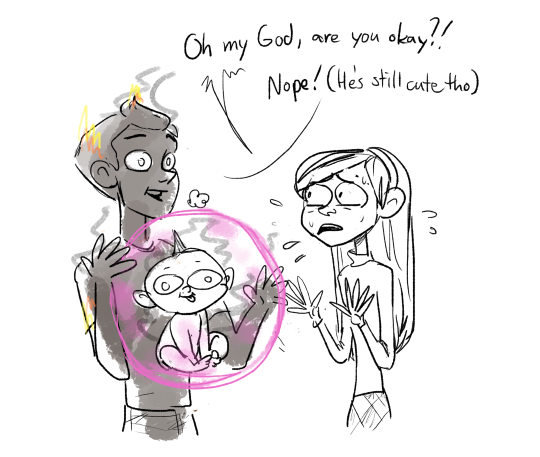
So people are reblogging this suddenly in mass since the Incredibles 2 came out and tagging it as that but this comic was out way before the movie was.
Also it’s a crossover lol That’s Wilbur from Meet the Robinsons, not Tony.
Violet Parr, everyone. The true hero of this movie.
I want an Incredibles 2 where Violet suddenly wakes up and realizes, ‘Why did I think wearing pink sweaters and dating some popular kid was AN IMPROVEMENT?!’ Then she goes back to being the quirky, smart girl she was at the start, only now she’s more badass than before because she realizes there was NOTHING WRONG WITH WHO SHE WAS!!!
(Seriously, am I the only one who hates how they ended her story in pt. 1?)
You SEVERELY misunderstand Violet’s entire dang story arc, and her characterization at the beginning of the film.
Like, I think you need to rewatch the film. At the beginning of the film, she was scared, self conscious, etc. Those aren’t “quirks” those were her hiding her quirks because she was afraid.
Her story arc was about gaining confidence. The wearing of brighter colors was symbolic of that. If you look at concept art, she was meant to be huddled, scared, trying not to be seen, etc. Those dark clothes are meant to show her trying to “blend in” and be less noticed.
That’s also why in the beginning, she lets her hair fall in front of her face: She’s trying TO HIDE. Think about it, she wants to be “normal” instead of embracing her powers, she wants to fit in, etc.
Look at her body language during this scene. Notice how she doesn’t want to talk, she mumbles, she won’t even eat. Something is bothering her, but she doesn’t want to admit it. She constantly looks sad. Heck, I’m kind of mad at Helen in this scene for not acknowledging it. Violet’s body language is FREAKING OBVIOUS, any mother should be able to spot it, and ask what the frick is wrong, but Helen’s so preoccupied with trying to be a “normal” family that she completely ignores any signs that something is wrong.
And then we get to the problem: When Violet screams about how no one in the family is “normal”
“We ACT normal, Mom! I wanna BE normal!” and Dash even agrees, because of the pressure to act “normal” that is put on him.
She doesn’t want to “be herself” she wants to “fit in”
She has basically been told her whole life to hide who she is, hide her powers, etc to keep the family safe. She’s barely allowed to express herself, something Helen acknowledges later in the film indirectly by apologizing for putting pressure on Violet. She’s not just talking about the plane crash, she’s talking about what she’s basically done to Violet and Dash THEIR ENTIRE FREAKING LIVES. She basically did the same dang thing Elsa’s parents did in Frozen: “Conceal, don’t feel, don’t let it show” but she never gets called out on it, because she doesn’t die before realizing her mistake and fixing it.
That’s why after the talk with her Mom, it’s SO DANG IMPORTANT that she pulls her hair back: SHE’S DONE HIDING WHO SHE IS. She’s DONE trying to pretend to be normal. She realizes she is someone incredible, and is finally willing to embrace that.
Later, when she’s wearing bright clothes, it symbolizes she’s no longer afraid of being seen. She’s willing to stand out instead of blend into the background. Seriously, this is some basic cinematography symbolism, here, it’s one of the first things you learn in a film-as-literature class. Her outfit change didn’t mark a change in
Violet doesn’t become a different person. She learns to be confident with who she is.
She didn’t change who she was. She gained confidence. Confidence to talk to the boy without turning invisible. Confidence to ask him out. The moral of her story wasn’t “LOL those darn introverts need to be extroverts” the moral was “You can do whatever you set your mind to. If you can stop a literal supervillain, you can freaking ask the dang boy out.”




 XI's Archived Tumblr Blog