Shout out to my Arabic teacher that looked at us yesterday mid-lesson and said, “I’m worried. You all look exhausted and depressed.”
Of course we were all like, “Oh yeah we’re dead inside, you haven’t noticed?”
And he snapped shut the textbook, threw up his hands and said, “That’s not healthy! No more vocab! Time for dancing!”
And he taught us a dance from Iraq and we danced instead of doing vocab. We didn’t stop dancing until he saw all of us laughing and was satisfied that we were all feeling better. It was perhaps the coolest, most kind-hearted thing I’ve ever seen a college instructor do.
It’s sad that toxic game culture is so prevalent cuz like. As someone who has ended up in random matches with kids before, I can attest to how fucking easy it is to reverse and un-teach shitty attitudes in kids.
Example: I downloaded Friday the 13th because it’s free on psn. I dunno how to play, so I just enter quick play and I’m matched with 3-4 kids on mic. Immediately on mic they’re shitty and disparaging to each other. They laugh at each others deaths, they actively work against team mates and self sabotage, they call each other “fags”, etc. From the sounds of the voices they cannot be older than 13-14.
I put on my mic and just decide I ain’t havin it. I am nice. I thank them for barricading doors or leaving me items. When they break free from Jason’s grasp I say “good job!” or I try to help them. One kid survived for most of the match by himself. When he dies, I tell him he did a fantastic job.
The mood shift is practically INSTANT. These kids almost immediately stop being dick heads. They start encouraging each other and being kind. After the match all of them try to friend request me. Which should tell you a couple of things:
A) kids want to be kind, and they want to have a nice time playing games. But encounters with adults like me or so rare that they’ve trained themselves to instantly put on a toxic, shitty, defensive veneer when encountering any new person online. It’s literally just THAT EASY to not groom a horrible gaming community, it’s just that NO ONE does it.
B) the speed of which they all tried to friend me was cute, but paints for me such a sad picture? Like these kids are SO desperate to find people to play with who aren’t crappy jerks. They played with me for 10 minutes TOPS and all instantly tried to reach out to me.
tl;dr: The kids are alright. Adults are shit heads.
Am I the only one whose internet addiction started with my parents not letting me fucking go anywhere
This but I also had no friends so I wouldn’t have anywhere to go if I was allowed
this is a thing! danah boydis a researcher who has been studying social media for over a decade and in her 2014 book it’s complicated she argues that teenage social media “addiction” (which she also contends is like…..not actually a thing) is a result of the fact that “today’s teenagers have less freedom to wander than any previous generation” because “parents argue that these restrictions are necessary in an increasingly dangerous society, even though the data suggest that contemporary youth face fewer dangers than they did twenty years ago.”
as a result, teenagers are reclaiming these lost social spaces (which their parents and grandparents had in the form of mall hangouts, drive-in theaters, after school parking lots, etc) by using social media, where they can continue to “engage in crucial aspects of maturation: self-presentation, managing social relationships, and developing an understanding of the world around them,” aka stuff that teens are Supposed to be doing
I honestly don’t know how to tell you these shocking facts but fucked up things in stories were not invented by AO3
I literally saw that someone replied to a post that talked about content in public libraries saying that that content should be regulated as well and Im just like when your statement can’t be distinguished from something a Southern Baptist pastor would say you really need to take a hard look at what kind of belief system you’ve let yourself fall into.
When fiction deals with difficult material (as it almost inevitably will) and it’s available for public consumption, you have the choice to ban anything controversial or teach people from a young age how to analyse and interpret literature and media. Only the second option builds valuable thinking skills and is actually possible.
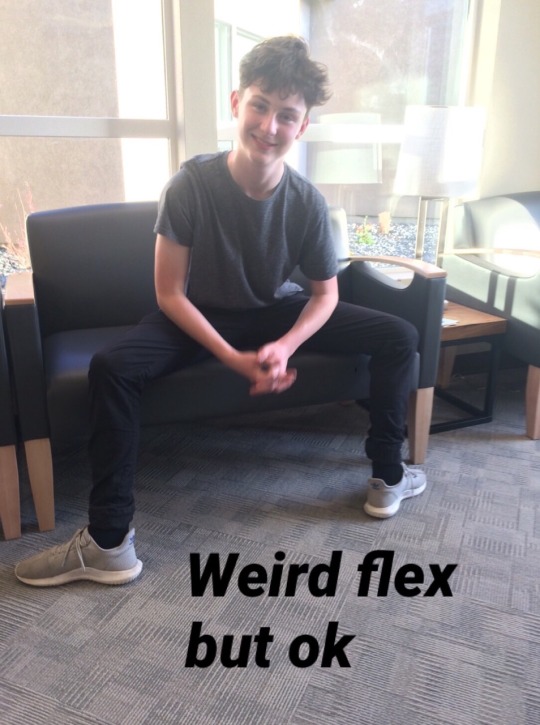
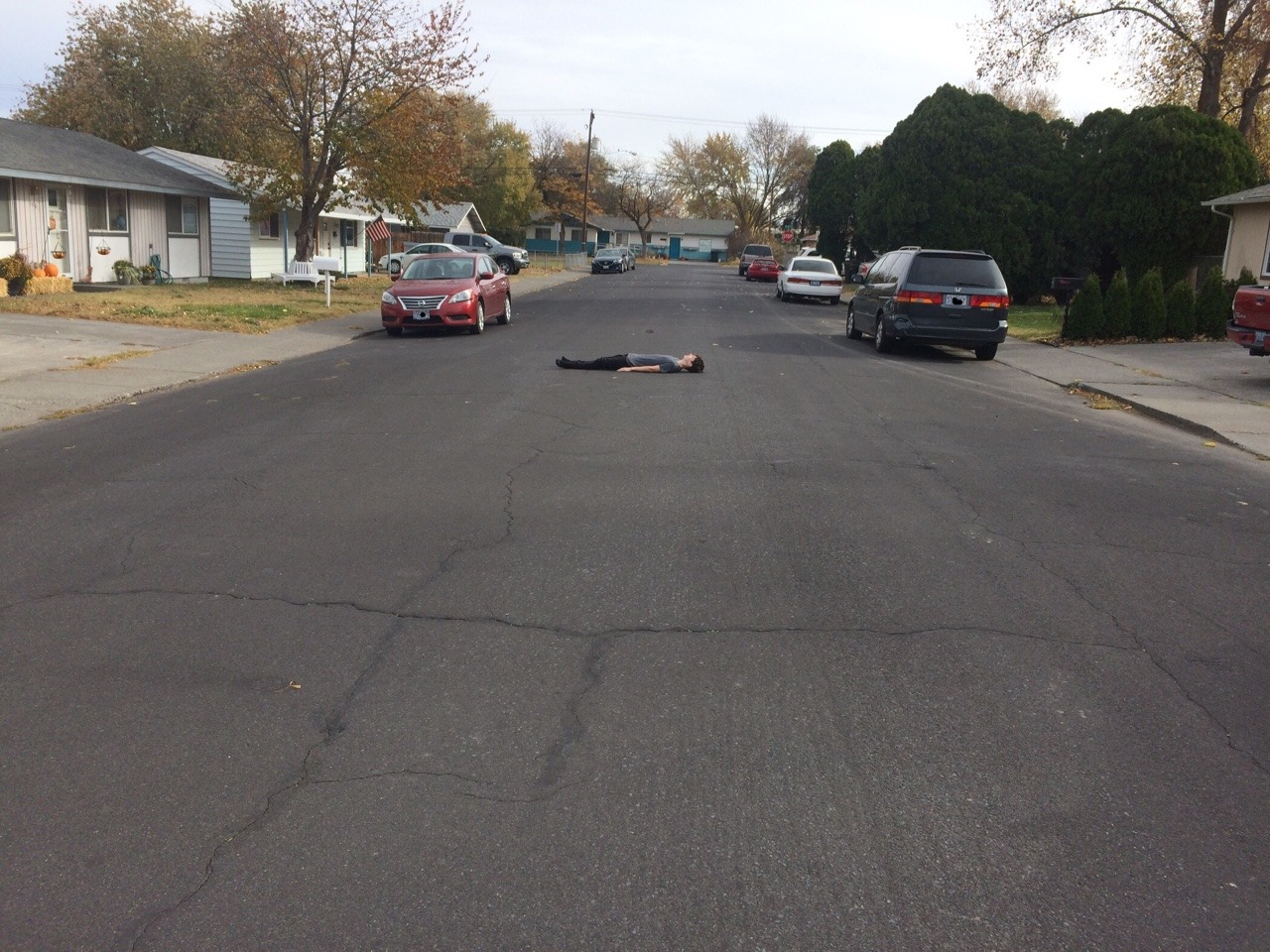
So I’ve been ruining my kids lives by saying “weird flex but ok” to everything and when I do it they scream no and tell me they’re running away and I made this lovely photo lemme get it
Ok so I need some help coming up with the absolute worst “to flex on” live memes ever to pretend I’m an even more really lame parent. they don’t have to make sense but they need to be absolutely awful yet believable enough that it isn’t obvious I’m intentionally trying to be more lame
Here’s the ones I came up with so far
“You ever just eat a well balanced diet and exercise daily to flex on heart disease?”
“You ever just boil chilies to flex on your eyes?”
“You ever just be cool to flex on your kids?”
“You ever just use sanitizer to flex on 99.9% of all bacteria and viruses?”
“You ever just turn all the lights and up the heater to flex on Dad?”
Catholic edition:
“You ever just like receive the sacraments frequently to flex on Satan?”
“You ever just like love your Mom to flex on Protestants?”
So I executed the first one in the kitchen then I dabbed and my son didn’t say anything he just set down his pomegranate and walked out the front door with no shoes on and now he’s walking down the street
Coraline is a masterfully made film, an amazing piece of art that i would never ever ever show to a child oh my god are you kidding me
Nothing wrong with a good dose of sheer terror at a young age
“It was a story, I learned when people began to read it, that children experienced as an adventure, but which gave adults nightmares. It’s the strangest book I’ve written”
This is a legit psychology phenomenon tho like there’s a stop motion version of Alice and Wonderland that adults find viscerally horrifying, but children think is nbd. It’s like in that ‘toy story’ period of development kids are all kind of high key convinced that their stuffed animals lead secret lives when they’re not looking and that they’re sleeping on top of a child-eating monster every night so they see a movie like Coraline and are just like “Ah, yes. A validation of my normal everyday worldview. Same thing happened to me last Tuesday night. I told mommy and she just smiled and nodded.”
Stephen King had this whole spiel i found really interesting about this phenomenon about how kids have like their own culture and their own literally a different way of viewing and interpreting the world with its own rules that’s like secret and removed from adult culture and that you just kinda forget ever existed as you grow up it’s apparently why he writes about kids so much
An open-ended puzzle often gives parents math anxiety while their kids just happily play with it, explore, and learn. I’ve seen it so many times in math circles. We warn folks about it.
Neil Gaiman also said that the difference in reactions stems from the fact in “Coraline” adults see a child in danger – while children see themselves facing danger and winning
i never saw so much push back from adults towards YA literature as when middle aged women started reading The Hunger Games. They were horrified that kids would be given such harsh stories, and I kept trying to point out the NECESSITY of confronting these hard issues in a safe fictional environment.
SAGAL: No. I mean, for example, your incredibly successful young adult novel “Coraline” is about a young girl in house in which there’s a hole in the wall that leads to a very mysterious and very evil world. So when you were a kid, is that what you imagined?
GAIMAN: When I was a kid, we actually lived in a house that had been divided in two at one point, which meant that one room in our house opened up onto a brick wall. And I was convinced all I had to do was just open it the right way and it wouldn’t be a brick wall. So I’d sidle over to the door and I’d pull it open.
(SOUNDBITE OF LAUGHTER)
SAGAL: Right.
GAIMAN: And it was always a brick wall.
SAGAL: Right.
GAIMAN: But it was one of those things that as I grew older, I carried it with me and I thought, I want to send somebody through that door. And when I came to write a story for my daughter Holly, at the time she was a 4 or 5-year-old girl. She’d come home from nursery. She’d seen me writing all day. So she’d come and climb on my lap and dictate stories to me. And it’d always be about small girls named Holly.
SAGAL: Right.
GAIMAN: Who would come home to normally find their mother had been kidnapped by a witch and replaced by evil people who wanted to kill her and she’d have to go off and escape. And I thought, great, what a fun kid.
It’s anxious adults who desperately want to “soften” stories. Kids prefer the real thing: with monsters, bloodthirsty ogres and evil murderous stepmothers; where the littlest brother always wins and all the villains are horrendously punished in the end. The world is threatening to the eyes of a child, so they need a fictional universe where the little people have a fair chance against the big and strong.
This isn’t specifically about stop motion but it is about how sad or scary parts of movies aren’t really all that bad- IE the 80′s movies, particularly Don Bluth’s films. (X- The Melancholy of Don Bluth, by Meg Shields )
How the children’s animation of the 80’s made room for sadness, and what that taught us.
There was a time when McDonalds used to give away VHS tapes with happy meals, and by some stroke of luck, one day my mom picked The Land Before Time. It
was the first film to etch itself onto me ‐ the way film tends to with
kids. I would recreate the plot with stuffed animals and parrot the
lines to whoever would listen; I pawed that VHS box until the cardboard
went soft.
A couple years ago, I saw that Land Before Time
was playing on t.v. and couldn’t remember the last time I’d watched it
all the way through. Within five minutes I was completely obliterated
and sobbing into a throw pillow. This is a shared experience for
children raised with Don Bluth: that as a kid, I could only clock a hazy sense that his films felt different
from Disney fare, but that the articulations of this difference, and
their ability to emotionally floor me, are something I’ve only become
aware of in retrospect.
There was a regime change in animation
during the 80’s. Quite literally in the form of Bluth’s official break
with Disney in ’79, but in a more elusive sense with the landscape of
what children’s animation during that decade felt like. For
whatever reason, be it Bluth’s departure or a diseased managerial ethos
in the wake of Walt’s passing, the 80’s were a mixed bag for Disney.
Don’t get me wrong, they’re amiable and charming films, but The Fox and the Hound and The Great Mouse Detective are not classics. And for all its ambition, The Black Cauldron cannot be redeemed on technical merit. Disney would eventually yank itself out of its slump in ’89 with The Little Mermaid ‐ but animation during the 80’s, along with the childhoods of a slew of millennials, were definitively shaped by Bluth.
That there is a dark tenor to Bluth’s work has been thoroughly, albeit perhaps vaguely, noted, often citing individual moments of terror (cc: Sharptooth, you dick). While I don’t doubt that frightening and disturbing scenes contribute to an overall sense of darkness in Bluth’s work, I’m unconvinced that they’re at the root of what distinguishes his darker tone. There is, I think, a holistic sadness to Bluth films; a pervasive, and fully integrated melancholy that permeates his earlier work.
These stories are full of crystalline moments of narrative sadness; specific story moments at which I inevitably mutter a “fuck you Don Bluth,” and try not to cry. There’s Littlefoot mistaking his own shadow for his dead mother; Fievel sobbing in the rain (a Bluth mainstay) convinced that his family has abandoned him; Mrs. Brisby shuddering helplessly after she and the Shrew temporarily disarm the plow. Other plot points are less tear-jerking so much as objectively miserable: the cruelty of the humans in The Secret of NIMH; An American Tail’s intelligent allegory for Russian Jewish pogroms and immigration; Carface getting Charlie B. Barkin drunk and murdering him at the pier.
You know — FOR KIDS!
Thematically, there is an ever-present air of death about Bluth’s work that is profoundly
sad. Bones litter certain set-pieces; illness and age are veritable
threats (shout out to Nicodemus’ gnarly skeleton hands); and characters
can and do bleed. Critically, Bluth films don’t gloss over
grief, they sit with it. From Littlefoot’s straight up depression
following the on-screen death of his mom, to Mrs. Brisby’s soft sorrow
at finding out the details of her husband’s death.
There is a space for
mourning in Bluth’s stories that feels extra-narrative, and
unpretentious. Critically, this is distinct from, say, wallowing.
Bluth’s films have a ridiculously productive attitude towards mourning,
most lucidly articulated through Land Before Time’s moral
mouthpiece Rooter: “you’ll always miss her, but she’ll always be with
you as long as you remember the things she taught you.” Disney
meanwhile, tends to treat death as a narrative flourish, or worse, a
footnote. And in comparison, even notable exceptions like Bambi and The Lion King seem immaturely timid to let palpable grief linger for longer than a scene, let alone throughout a film’s runtime.
Look at all the fun times they’re missing.
Musically, James Horner and Jerry Goldsmith’s impossibly beautiful scores are laced with a forlorn undercurrent. In particular, Horner’s tonal dissonance in The Land Before Time theme punches the Wagner-lover in me in the throat (admittedly, a good thing). Further to this, the first half of Goldsmith’s “Escape from N.I.M.H,” is reminiscently Tristan and Isolde-y. And while I’m here, I would also like to formally issue a “fuck you for making me cry in public” to American Tail’s “The Great Fire,” which when combined with visuals, is nothing short of devastating.
Speaking of visuals, backdrops of grim and vast indifference dot Bluth’s work; from the twisted Giger-esque caverns of the rats’ rosebush, to the urban rot of a thoroughly unglamorous New York and New Orleans. That these landscapes are in a state of decay is particularly dismal; there is a tangible barrenness, a lack of the warmth our characters are desperately hoping to find by their film’s end. These are depressed and morose spaces ‐ and that they are so seemingly unnavigable and foreboding makes them all the more compelling, and narratively resonant.
The way Bluth uses
color is also notable, with dark, earthy tones prevailing throughout
only to be blown out quite literally with the golden light
characteristic of Bluth’s hard-earned happy endings. Before Littlefoot
and friends reach The Great Valley, an event marked by gradually
illuminating god-rays, they must slug it out through the parched browns,
blues and pitch of their prehistoric hellscape. Like Charlie’s final
ascendance into heaven, Fievel must endure similarly muted shades until
he is finally (finally) reunited with his family and soaked in
glitter ‐ a level of Don Bluth conclusion-sparkles perhaps only rivaled
by the radiance of Mrs. Brisby’s amulet as she Jean Grey’s her homestead
to safety at the end of NIMH. Because Bluth leans into darker,
less saturated tones, these effervescent conclusions are all the more
impactful, which speaks in part to the methodology of Bluth’s
melancholy.
The plucky leads of Bluth’s early films are all
fighting for the same thing: family. From Mrs. Brisby’s persistence to
protect her children, to Charlie’s (eventually) selfless love for
Anne-Marie, these are characters in search of home. Invariably, each of
these characters gets their happy ending, but they have to go through
hell to get there, literally in Charlie’s case. In a recent interview,
critic Doug Walker asked Bluth if there was any truth to the rumor that
he thinks you can show children anything so long as there’s a happy
ending, to which Bluth replied:
“[If] you
don’t show the darkness, you don’t appreciate the light. If it weren’t
for December no one would appreciate May. It’s just important that you
see both sides of that. As far as a happy ending…when you walk out of
the theatre there’s [got to be] something that you have that you get to
take home. What did it teach me? Am I a better person for having
watched it?”
Melancholy isn’t just a narrative device
for Bluth, it’s a natural part of navigating life, of searching for
wholeness, and becoming a better person. Bluth acknowledges sadness in a
way that never diminishes or minimizes its existence; he invites
melancholy in, confesses its power, and lets it rest. Sadness is, for
Bluth, an essential characteristic of the world and living in it. That
is a wholly edifying message for kids, delivered in a vessel that is
both palatable and unpatronizing. For this reason, among innumerable
others, Bluth’s work has immense value as children’s entertainment…even
if it means crying into a throw pillow twenty years later.
Maternity and paternity leave is really important, paternity leave is, I think, a really important part of equality. Normalise the idea that men will raise children, be these men hetero or gay.
All parents need time to bond with a new baby, and time to acclimate themselves to all that’s required to care for one.
On top of forming a connection with their child, this can help to simplify distribution of labor when it comes to childcare. This way, there isn’t just one parent doing everything most of the time and then one confused parent in over their head anytime the other hands the baby off so they can go shower, get some food in them, go shopping/to a meeting, etc.
ALSO a woman will need weeks and months to heal from the birth. My husband always felt so guilty about leaving back to work just two weeks after the baby was born with BOTH our kids, because he knew I was still figuring out breastfeeding, getting used to the new baby, far too tired to clean/cook, etc. He obviously helped out outside of work, but that is so much to ask of anyone to work 9-5 and then play homemaker on top of that. Fathers need rest and time to enjoy the baby too.
It’s honestly ridiculous that fathers are expected to only spare a few weeks (at most) post-labor. The mother just went through one of the most physically traumatic episodes the human body is capable of, she’s not going to be bouncing back to normal after a few weeks. It’s a critical time when the father is needed more than ever to ease the adjustment period.
I’ve seen people complain that paternal leave is a “scam”. Certainly a lot of companies seem to think so. But the truth is that our culture is so consumer/work based, that career and money is everything, that we (a) assume that any attempt at paid leave is gimmicking the system, and (b) that parenthood is not a reasonable thing to prioritize over making income
Fathers are often portrayed in media as helpless with children or unable to empathize as well as mothers. And you know what? There’s some truth to that because of how society depicts men’s roles in parenthood since the early 20th century. Their job is to make a living and discipline. Not spend time connecting to their offspring.
Let fathers bond with their kids. It starts at the beginning. Spare them at least a month to get to know their son or daughter. Let them enjoy getting to know each babies’ unique personality outside of late-night wake-ups. Without paternity leave, they must choose between being a good husband and father, or putting bread on the table.
so heres a thing my mother always said to me growing up when i broke something on accident that i think is really important
and i know, from watching my friends and seeing their panic and terror when something broke, that not only were not nearly enough children told this thing, many children were punished in place of being reassured
and thats heartbreaking
so heres the words from my mom that i was always told, and theyre the same words that anyone who never got to hear them should hear now, courtesy of my mom, who has repeated those same words to many a friend of mine and now to you
if i ever broke anything, the first words out of her mouth would always be and have always been, “are you hurt?”
i would say no
she would say, “thats okay, then”
and i would ask why
and she would say “because it was just a thing- even if its a nice thing, or an old thing, or an expensive thing, its still just a thing. it can be replaced, or we can live without it. there is only one you. there will only ever be one you. you will always be more important than just some thing.”
I lend out a collection to fossils to my school’s 8th grade science teachers annually. I’ve collected since I was a kid, added more as an adult from yard sales and donations. I want kids to be inspired and intrigued. About my 5th year at my school, the teacher came to me with one of her students. The girl looked upset and sort of scared. The teacher explained that the girl’s hand had slipped and a Megaladon Shark’s tooth had broken into two pieces. My first response was to make sure she hadn’t been cut by one of the pieces, and she shook her head, tears in her eyes. I smiled at her and pointed out that she hadn’t dropped it on purpose, that the ridiculously big tooth had been fossilized and survived this long, and it would still be amazing if I had to either keep it in two pieces or superglue it.
It bothered me a lot that the kid was clearly primed by a lot of adults to deal with anger and blame when a simple mistake was made. I offered her a hug, which she accepted and finally laughed.
Story time:
My grandmother owns crystal bowls that have been passed down to her from her grandmother. Being a family with Jewish heritage in Austria, every single piece of family history we own is basically a treasure in itself.
I was already an adult when she allowed me to take one of them home with me, of course only after I swore several oaths to keep it safe. I can go months and years without breaking a single dish, but lo and behold, it takes two weeks and a split second of not paying attention, and suddenly that crystal bowl, that’s worth more to my grandmother than the entire rest of her furniture, goes flying and shatters into a million pieces. I swear I watched for what felt like an hour as that thing dropped, turned around itself and finally crashed in a spectacular impact. Anyway, it’s completely beyond repair, and I’m freaking out because my grandmother will murder me. Only, she will not, because even worse, she’s going to be fucking heartbroken and so, so disappointed with me she won’t even find it within herself to murder me.
But, you gotta do what you gotta do – not being able to face her while confessing, I call her, in tears, apologizing a hundred times before she finally goes: “Gigi, calm down now, what happened??” “*sobbing* I- I broke your grandma’s bohooohooowl -”
And my grandmother, bless that woman, starts laughing hysterically. She’s laughing so much I think, I must have broken her, that’s it, she’s lost her marbles now and it’s my fault, until she wheezes out: “Gigi that bowl survived two world wars and the Nazis but not a month in your kitchen!” and of course I fucking lost it too at that point. That’s how I learned, that in the end, it’s really all about perspective.
Now I’m a step-mum myself and my go to reaction whenever I hear something break is to shrug and say ‘Well, it had a good run’ and then I go fetch a broom and we’ll clean up because if my grandma could laugh off a 100 year old crystal dish, I can laugh off an IKEA mug lmao




 XI's Archived Tumblr Blog