it’s hilarious to me when people call historical fashions that men hated oppressive
like in BuzzFeed’s Women Wear Hoop Skirts For A Day While Being Exaggeratedly Bad At Doing Everything In Them video, one woman comments that she’s being “oppressed by the patriarchy.” if you’ve read anything Victorian man ever said about hoop skirts, you know that’s pretty much the exact opposite of the truth
thing is, hoop skirts evolved as liberating garment for women. before them, to achieve roughly conical skirt fullness, they had to wear many layers of petticoats (some stiffened with horsehair braid or other kinds of cord). the cage crinoline made their outfits instantly lighter and easier to move in
it also enabled skirts to get waaaaay bigger. and, as you see in the late 1860s, 1870s, and mid-late 1880s, to take on even less natural shapes. we jokingly call bustles fake butts, but trust me- nobody saw them that way. it was just skirts doing weird, exciting Skirt Things that women had tons of fun with
men, obviously, loathed the whole affair
(1864)
(1850s. gods, if only crinolines were huge enough to keep men from getting too close)
(no date given, but also, this is 100% impossible)
(also undated, but the ruffles make me think 1850s)
it was also something that women of all social classes- maids and society ladies, enslaved women and free women of color -all wore at one point or another. interesting bit of unexpected equalization there
and when bustles came in, guess what? men hated those, too
(1880s)
(probably also 1880s? the ladies are being compared to beetles and snails. in case that was unclear)
(1870s, I think? the bustle itself looks early 1870s but the tight fit of the actual gown looks later)
hoops and bustles weren’t tools of the patriarchy. they were items 1 and 2 on the 19th century’s “Fashion Trends Women Love That Men Hate” lists, with bonus built-in personal space enforcement
Gonna add something as someone who’s worn a lot of period stuff for theatre:
The reason you suck at doing things in a hoop skirt is because you’re not used to doing things in a hoop skirt.
The first time I got in a Colonial-aristocracy dress I felt like I couldn’t breathe. The construction didn’t actually allow me to raise my arms all the way over my head (yes, that’s period-accurate). We had one dresser to every two women, because the only things we could put on ourselves were our tights, shifts, and first crinoline. Someone else had to lace our corsets, slip on our extra crinolines, hold our arms to balance us while a second person actually put the dresses on us like we were dolls, and do up our shoes–which we could not put on ourselves because we needed to be able to balance when the dress went on. My entire costume was almost 40 pounds (I should mention here that many of the dresses were made entirely of upholstery fabric), and I actually did not have the biggest dress in the show.
We wore our costumes for two weeks of rehearsal, which is quite a lot in university theatre. The first night we were all in dress, most of the ladies went propless because we were holding up our skirts to try and get a feel for both balance and where our feet were in comparison to where it looked like they should be. I actually fell off the stage.
By opening night? We were square-dancing in the damn things. We had one scene where our leading man needed to whistle, but he didn’t know how and I was the only one in the cast loud enough to be heard whistling from under the stage, so I was also commando-crawling underneath him at full speed trying to match his stage position–while still in the dress. And petticoats. And corset. Someone took my shoes off for that scene so I could use my toes to propel myself and I laid on a sheet so I wouldn’t get the dress dirty, but that was it–I was going full Solid Snake in a space about 18″ high, wearing a dress that covered me from collarbones to floor and weighed as much as a five-year-old child. And it worked beautifully.
These women knew how to wear these clothes. It’s a lot less “restrictive” when it’s old hat.
I have worn hoop skirts a lot, especially in summer. I still wear hoop skirts if I’m going to be at an event where I will probably be under stage lights. (For example, Vampire Ball.)
I can ride public transportation while wearing them. I can take a taxi while wearing them. I can go on rides at Disneyland while wearing them. Because I’ve practiced wearing them and twisting the rigid-but-flexible skirt bones so I can sit on them and not buffet other people with my skirts.
Hoop skirts are awesome.
Hoop skirts are also air conditioning. If you ever go to reenactments in the South, particularly in summer, you’ll notice a lot of ladies gently swaying in their big 1860s skirts – because it fans all the sweaty bits. You’ll be much cooler in a polished cotton gown with full sleeves, ruffles, and hoopskirt than in a riding jacket and trousers, let me promise you! (This is part of the reason many enslaved women also enthusiastically preferred larger skirts – they had more to do than sit in the shade, but they’d get a bit of a breeze from the hoops’ movement as they were walking.)
They’re also – and I can’t emphasize enough how important this is – really easy to pee in. If you’re in split-crotch drawers (which, until at least the 1890s, you were), you can take an easy promenade a few feet away from the gents and then squat down and pee in pretty much total privacy. It gives so much freedom in travel when it’s not a problem to pee most anywhere.
People also don’t realize that corsets themselves were a HUGE HUGE IMPROVEMENT over previous support-garment styles – and if you have large breasts that don’t naturally float freely above your ribcage (which some people’s do! but it’s not that common), corsets are often an improvement over modern bras.
They hold up the breasts from underneath, taking the weight of them off your back. Most historical corset styles don’t have shoulder straps, so you’re not bearing the weight of your breast there, either, and you can raise your arms as far as your dress’s shoulder line allows (which is the actually restrictive bit – in my 1830s dress, literally all I can do is work in my lap, but in my 1890s dress I can paddle a kayak or draw a longbow with no trouble. Both in a full corset). They support your back and reduce the physical effort it takes to not slouch, helping avoid back pain. They’re rigid enough that you don’t usually have to adjust your clothing to keep it where it belongs. They’re flexible – if you’re having a bloaty PMS day you just … don’t lace it as tightly, and if your back muscles are sore you can lace it a little tighter. And you can undo a cup (or, y’know, not have breast cups) to nurse a baby without losing any of the structural integrity of the garment.
I do educational/historical dressing and people are really insistent, like, “The corset was invented by a man, wasn’t it?” “Actually, women were at the forefront of changing undergarment styles throughout the 19th century!” “But it’s true that it was invented by a man.”
Uh, well, it’s hard to say who “invented” the style but it’s very likely that women’s dressmakers mostly innovated women’s corsets and men’s tailors mostly innovated men’s corsets, honey. Because those exist too.
And THIS is why lace was a worn primarily by royalty and aristocracy for so many centuries.. It was expensive and time-consuming to produce. Wearing it, and wearing LOTS of it was a blatant show of wealth and excessive consumption.
Mechanically-produced lace wasn’t really a thing until well into the 20th century, but there remains a wide gap between the quality of mass-produced and hand crafted
In general textile arts are highly underated considering the amount of skill and time needed to execute pretty much anything.
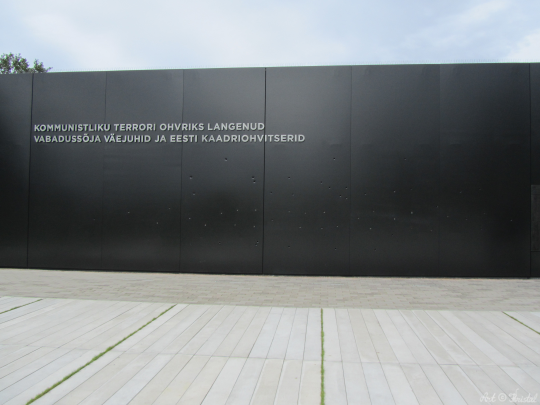
On the 23rd of August 2018, this memorial was officially opened. As you can tell by the name, it was built to commemorate those 22,000+ civilians (as well as serving officers) who died in an unknown place/time after the Soviet Union (SU) occupied our country.
Whether they were arrested and killed for being a threat to the new regime, deported to various prison camps across the SU territory or they didn’t make it through the long, treacherous journey in a cramped up train wagon (meant for animals), which took them away from their homeland, they never came back and their relatives have no idea when or where they died…
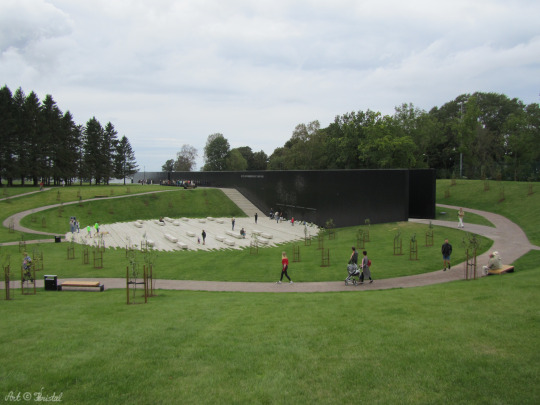
Well, now the victims’ friends and family have a place to go and commemorate them. I visited this memorial 2 days after it was opened to the public and will now share some photos I took to show you what it looks like.
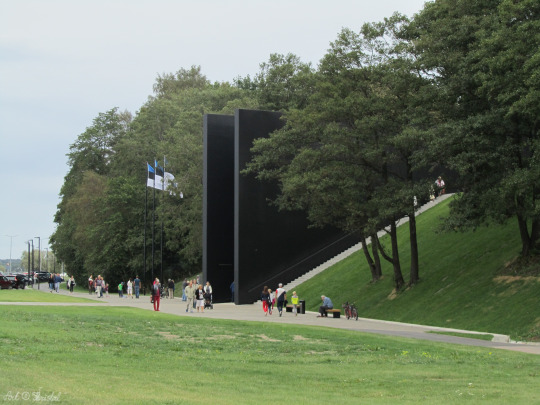
This is the entrance from the outside, which is surrounded by two tall black walls. On the inside of these walls are the 22,000+ victims’ names, inscribed on plaques. If you enter it, you are going on the Journey.
The Journey through these walls symbolises the merciless power of the totalitarian system. It’s supposed to make you feel.. how should I say this?.. Oppressed. You’re surrounded, but you sort of want to break free from this tight space, right? Well, the thing is you can’t, because your freedom has been taken away from you. You can’t break free, not until you come to the end of the Journey. The names on either side of you remind you that not everyone survived this ordeal.
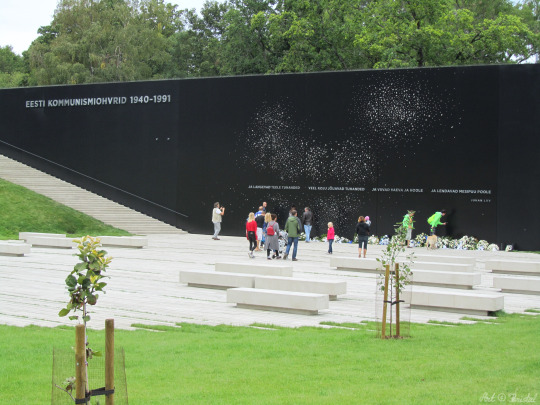
Once you finish the Journey, you reach the Home Garden. I quote: “The Home Garden is a place where dreams, memories and the yearning for home are intertwined. Apple trees and honeybees are the symbols of the Home Garden.” (X)
When you move closer to the wall, you can see the honeybees spread across it in bigger or smaller bunches, trying to protect each other. This idea came from a poem entitled “Ta lendab mesipuu poole”, written by an Estonian poet, Juhan Liiv. It’s also been made into a song, which is usually sung during our annual Song Festivals.
The lyrics have a very deep meaning behind them (which is why a lot of the singers cry when they sing this). In a literal meaning, it talks about how a family of bees works hard and some of the workers may die while on duty. But when their home (the honeycomb) is in danger, they hurry back to protect it without hesitation, not caring whether they die in the process or not.
As I interpret/see it, this actually represents Estonians and our love for our country. How we work together through better or worse so we could all live in peace. And when our homeland is being attacked, we come together and defend it with our lives.
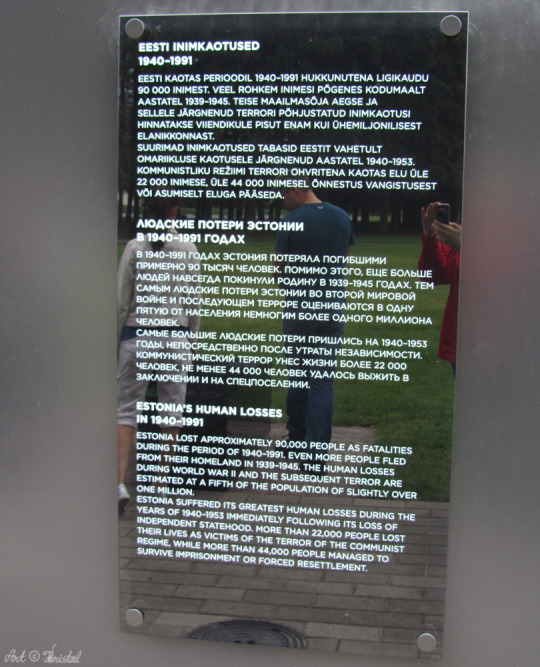
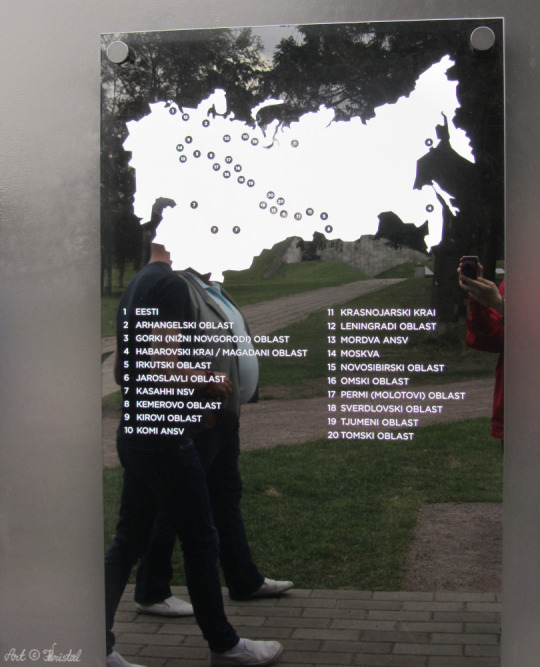
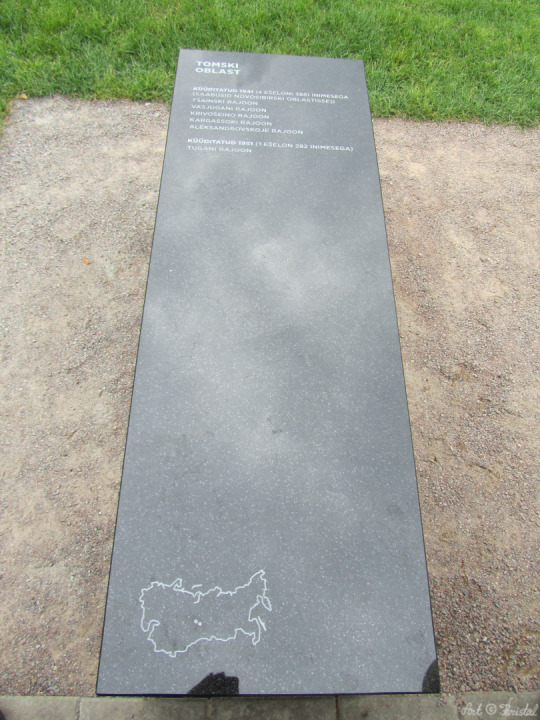
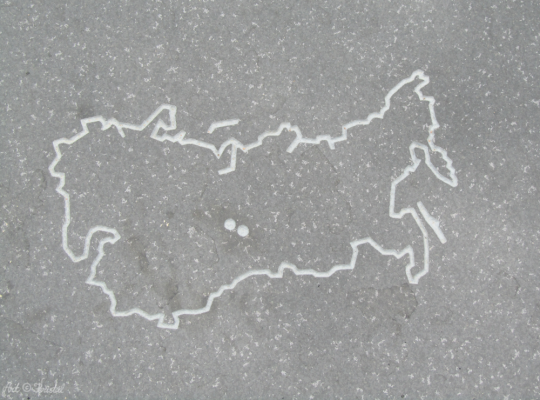
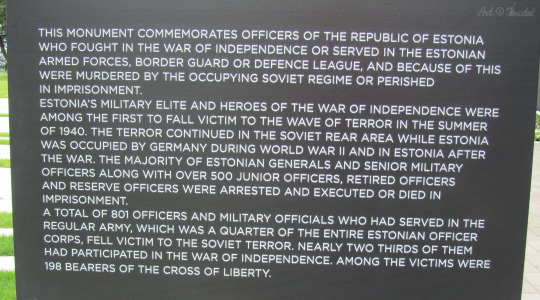
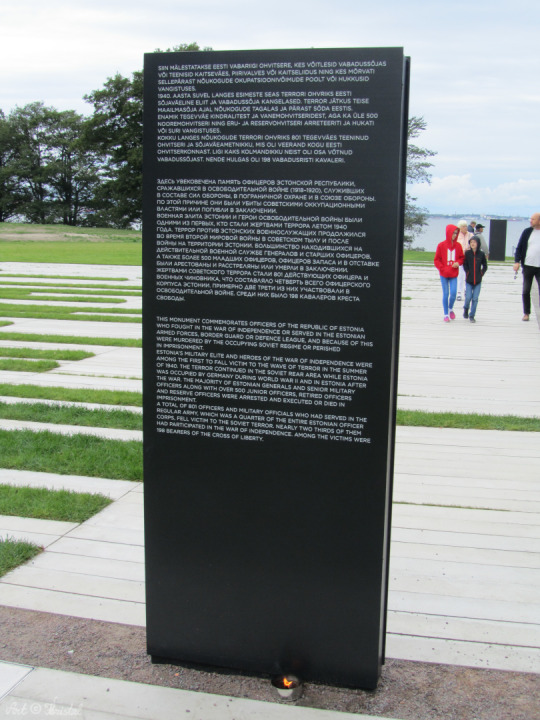
Once you walk past the honeybees and up the stairs, you reach a long row of information texts and location stones (these reminded me of coffins) running along the wall. They contain detailed facts about what happened during those 50 years of communist terror, the stones name the locations where deportees/prisoners were taken/died (along with a map of the SU, showing the locations). I took pictures of every board, but you can all read the texts here.
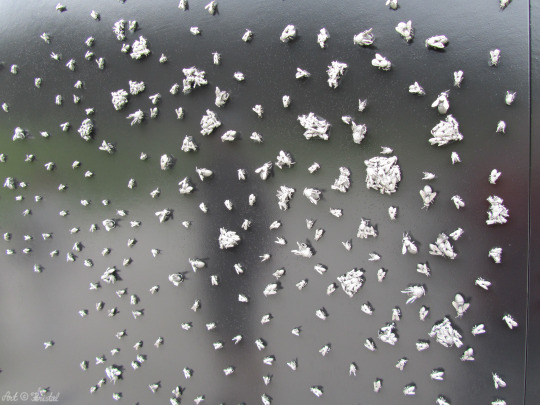
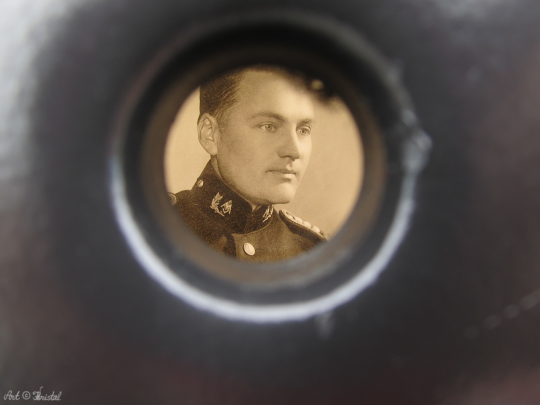
At the beginning, I mentioned that there’s a part of the memorial that commemorates the serving officers who were murdered. Now we reach the final part, and this is what it looks like: bullet holes on the side of the wall. If you peek inside, you will see that most of them contain an old photograph of an officer, who was among the victims.
To me, this memorial also stands as a reminder of why Estonians are on their toes when it concerns our eastern neighbour, Russia, whose “public secret” is that they wish to restore their former glory (i.e. they wish to reconquer Eastern Europe and regain more power in this region). Have you heard what happened to Georgia in 2008? Do you know what’s been going in Eastern Ukraine since 2014?
This is why I hope to live long enough to see the day when Russia apologizes and takes responsibility for its war crimes. These are the reasons why we must never forget – for if we do, we will let history repeat itself.
In conclusion, I’ve read many more historical posts about how/why nazism is bad on this site, but rarely (if at all) have I come across a similar post about communism. The stories that smaller cultures/people/nations have to share about their history aren’t as “popular” or don’t get the attention they deserve. Yet it’s the minorities who we should stand up for and protect.
Please, if you think that others should know more about the history of my people, of my country, then I urge you to reblog this. This will not look ugly on your blog. Thank you for reading (and sharing)!
Of course it’s going to destroy the concept of the starving artist, they are either going to be making propaganda or dead
Have fun in the gulags, all my favorite artists. :c
DESTROYING CAPITALISM WILL DESTROY THE ARTIST
Under communism, everyone must contribute something defined by the government to be of sufficient value, usually producing a specific product assigned to them by the government. Failure to do so results in imprisonment at best.
Under anarchy, those who spend their time and resources on non-survival pursuits will be subjugated or destroyed by more violent or ambitious members of the population.
The survival of the artist requires sufficient governmental structure and police presence for someone with no “practical” skills to remain safe, sufficient individual freedom for a person to choose their own, unconventional path rather than being defined by others, and sufficient economic power to be possessed by individuals that value can be given to something which has no practical use simply because it interests or entertains other individuals.
REMINDER THAT THE ONLY ARTISTS THAT FLOURISHED IN THE SOVIET UNION ARE FUCKING STATE-PROPAGANDA PAINTERS, YOU ABSOLUTE MONGRELS.
Reminder that Capitalism enables artists to MONETIZE their work and we shouldn’t shame artists for selling shit.
PRODUCE VALUE. MAKE MONEY. THAT IS THE WAY. Thanks to the digital age, literally anyone can find a way to make money. We’re living in a fucking golden age.
Pour one out for all the “artists” who died in the parallel universe where communism took over. They were sent to the gulags after they found out that performance art where they shit on stage and menstrual blood self portraits were deemed worthless by their Communist government. Pray for all the artists who survive in the same parallel universe by painting countless propaganda posters for the government to create the illusion of prosperity and progress.
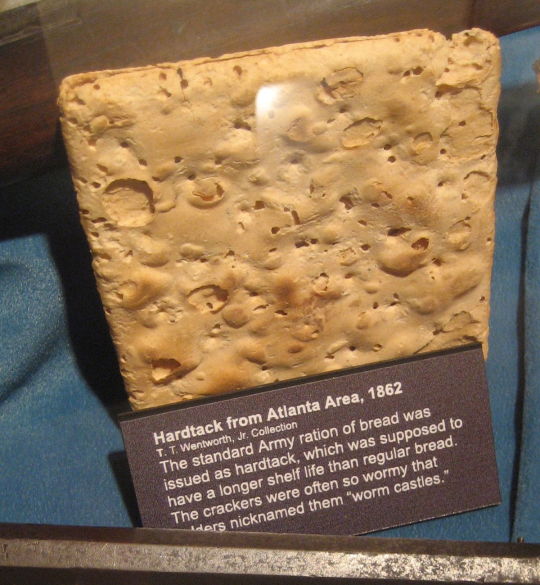
an edible cracker with just one side. mathematically impossible and yet here I am monching on it.
‘scuit’ comes from the french word for ‘bake’, ‘cuire’ as bastardized by adoption by the brittish and a few hundred years
‘biscuit’ meant ‘twice-baked’, originally meaning items like hardtack which were double baked to dry them as a preservative measure long before things like sugar and butter were introduced. if you see a historical doccument use the word ‘biscuit’ do not be fooled to think ‘being a pirate mustve been pretty cool, they ate nothing but cookies’ – they were made of misery to last long enough to be used in museum displays or as paving stones
‘triscuit’ is toasted after the normal biscuit process, thrice baked
thus the monoscuit is a cookie thats soft and chewy because it was only baked once, not twice
behold the monoscuit/scuit
Why is this called a biscuit:
when brittish colonists settled in the americas they no longer had to preserve biscuits for storage or sea voyages so instead baked them once and left them soft, often with buttermilk or whey to convert cheap staples/byproducts into filling items to bulk out the meal to make a small amount of greasy meat feed a whole family. considering hardtack biscuits were typically eaten by dipping them in grease or gravy untill they became soft enough to eat without breaking a tooth this was a pretty short leap of ‘just dont make them rock hard if im not baking for the army’ but didnt drop the name because its been used for centuries and people forgot its french for ‘twice baked’ back in the tudor era, biscuit was just a lump of cooked dough that wasnt leavened bread as far as they cared
thus the buttermilk biscuit and the hardtack biscuit existed at the same time. ‘cookies’ then came to america via german and dutch immigrants as tiny cakes made with butter, sugar/molasses, and eggs before ‘tea biscuits’ as england knew them due to the new availability of cheap sugar- which is why ‘biscuit’ and ‘cookie’ are separate items in america but the same item in the UK
the evolution of the biscuit has forks on its family tree
I love it when a shitpost turns into an actually interesting post.
Hey everyone how’s ur day im in traffic bc a fucking plane crashed on the freeway
Average day on a california freeway
is. that a Luftwaffe plane??
It sure is!
Some veteran grandpa pulled out a machine gun during the family BBQ and shot it down
…………..no he didn’t. he literally did not spend money on that. you just made that up.
the plane is owned by the Condor Squadron Club, a non-profit organization founded by WWII pilots. the organization restores and flies WWII planes for reenactments and commemorative parades in order to educate people about history and celebrate WWII vets.
the organization also runs an aviation museum at the Van Nuys airport and maintains the Portal of The Folded Wings Shrine to Aviation, a shrine built on the burial site of 15 pioneers in aviation, including Elizabeth Lippinscott McQueen, one of the first female pilots in America and the founder of the Women’s International Association of Aeronautics. they also do community service.
the pilot of this plane that crashed is a commercial pilot and historical reenactor. a mechanical failure caused the crash and he had to be pulled out by rescuers after the plane burst into flames and he became trapped.
he’s not a fucking nazi and i’m glad he’s okay. some of y’all need to fucking sit down.
There’s another story that I like about a Chinese general who had to defend a city with only a handful of soldiers from a huge enemy horde that was in all likelihood going to steamroll the place flat within hours of showing up.
So when said horde did arrive, they saw the general sitting outside the city’s open gates, drinking tea. The horde sent a couple of emissaries over to see what was what, and the general greeted them cheerfully and invited them all to come and take tea with him.
The horde decided that this was a scenario that had “MASSIVE FUCKING TRAP” written all over it in beautiful calligraphy and promptly fucked off.
Whoever that general was, he was clearly the Ancient Chinese equivalent of Sam Vimes.
did he just invite us over for tea nah man i’m out
This just keeps getting better
I fucking love history.
ok but tbh that story misses a lot of the subtlety of the situation like ok
so this story is the Romance of Three Kingdoms, and essentially takes place between Zhuge Liang, resident tactician extraordinaire, and Sima Yi… OTHER resident tactician extraordinaire.
The two were both regarded as tactical geniuses and recognized the other as their rival. Zhuge Liang had a reputation for ambushing the SHIT out of his opponents and using the environment to his advantage, thus destroying large armies with a small number of men. Sima Yi (who kind of entered the picture later) was a cautious person whose speciality was unravelling his opponent’s plans before they began. So it was natural that the two would butt heads; however, since Sima Yi tended to have more men and resources, he started winning battles against the former. Which, y’know, kinda sucked.
On to the actual story: Zhuge Liang is all like “shit i gotta defend this city with like 10 men.” Literally if he fights ANY kind of battle here, he WILL lose; his only option for survival is not to fight. And that’s looking more and more impossible until he hears that his rival is leading the opposing army. And then he gets this brilliant idea. He basically opens all the gates, sends his men out in civilian clothes to sweep the streets, and sits on top of the gate drinking tea and chilling out and basically makes the whole thing out to be a trap
When Sima Yi comes he’s all like “yo come on in bro”
and Sima Yi is like “yeah he’s never been that obvious about his traps before. this is definitely a bluff” and he’s about to head in when he realizes
wait. he knows that i think he’s bluffing.
and so he gets it in his head that maybe, just MAYBE, Zhuge Liang has this cunning plan that will wipe out his army – recall that he has a pretty good handle on what his rival is capable of. And after a long period of deliberation (which is just like “he know that I know that he knows that etc.”), being the cautious man he is, SIma Yi eventually decides to turn his entire army around and leave.
Zhuge Liang later points out that the plan was based specifically on the fact that he was facing his rival; if it had been anyone else, there’s no way it would have worked. A dumber or less cautious person would have simply charged in and won without breaking a sweat.
and that’s the real genius here: it was a plan formed entirely just to deceive one man, and it worked.
Zhuge Liang is the most brilliant, sneaky-ass bastard in history. One time his side’s army was out of arrows, which pretty much meant they were screwed. So Zhuge Liang goes and does the logical thing, which is build a fuck ton of scarecrows and put them all on boats. Then he makes the men hide in the boats and sail them out on the river.
Well, that day was super foggy (which Zhuge Liang had predicted. Did I mention he was also a freakishly accurate meteorologist?). So the enemy across the river sees a fleet of boats armed to the teeth with what appears to be half an army of men. They panic! and start firing arrows like crazy.
Zhuge Liang lets this play out for a while, then he’s like, ”Ok guys that’s enough.” They calmly turn the boats around and go back to base, where they dismantle the scarecrows and pull out all the enemy’s arrows.
Zhuge Liang is legend.
I love this post. It just keeps getting better. Like seriously, I would have adored learning about this in World History.
If you want to see this in cinematic glory, watch Red Cliff.
Especially since it makes Zhuge Liang look like this:
Red Cliff is 50% bloody battles and 50% eye candy and about half of that eye-candy is due to Zhuge Liang
I fully support watching Red Cliff; it’s gloriously silly entertainment during the battle scenes.
Guess what just got moved to the top of my watch list?? 😀



















 XI's Archived Tumblr Blog